03 August 2026
What is the Payback of a Lareka BTB25 Chocolate Packaging Machine?
Updated: 03 August 2026
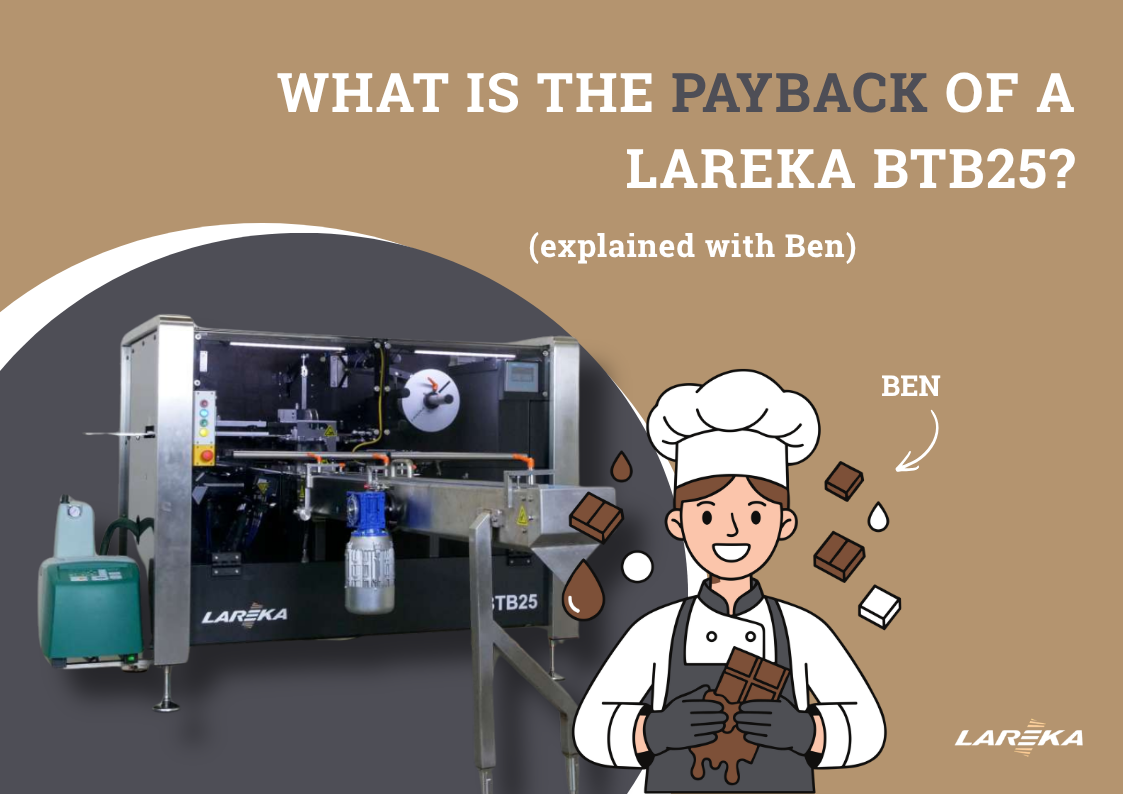
Throughout the years we have noticed that chocolate manufacturers often do not realise that wrapping bars by hand can be quite expensive. Although buying a machine seems to be a big expense at first, wrapping by hand does have some hidden costs and it is important to be aware of the difference between the two before making a decision. That is why in this article we are going to answer one question that we hear all the time: What is the payback period of a Lareka machine?
As an example for our analysis, we will use a ‘made-up’ chocolatier and we’ll name him Ben.
Ben lives in The Netherlands and he produces an average of 100.000 chocolate bars per year. Ben wraps his bars in golden metalized paper and a cardboard box. He buys pre-cut sheets of foil and pre-glued and pre-folded boxes.
Ben has perfected his recipe. The tempering is spot on, molds are clean, and the bars look exactly how he imagined them. But every day, his team is still folding paper/cardboard around each bar, one at a time. These costs are often easy to miss.
Let’s calculate it!
The hidden costs of hand-wrapping
In Western Europe, the cost of employing an operator is around 30 euros per hour (including social benefits). From our customers’ experience and further research, we learned that an operator takes around 1 minute to wrap 1 chocolate bar (including breaks, lunch time, etc.). As a result of this, each wrapper chocolate bar carries a labour cost of 50 cents per operator. As our chocolatier Ben produces 100.000 bars per year, that equals to a 50.000 euros in annual labour, just for wrapping.
However, there is an extra cost that is often overlooked: the price of packaging materials. When operators wrap chocolate bars by hand, they often make use of pre-folded and pre-glue cardboard boxes as they are easy to fold and close. The price of such boxes can vary from 20 cents to 70 cents. We will use the average, which is 45 cents for the calculation. Thus, the material (pre-folded cardboard boxes) adds an extra 45 cents per bar and considering the 100.000 bars, it adds up approximately another 45.000 euros per year only in materials, which is a significant amount compared to automated packaging with a machine. If we combine this amount with the one previously calculated, hand wrapping ends up costing Ben nearly €95,000 per year, almost double what the labour cost alone suggested.
What difference does the BTB25 make in terms of costs?
The BTB25 automatic wrapping machine handles between 25 bars per minute thus, in production including stops, changing foil and labels, lunch breaks, etc. you can wrap up to 10,000 bars in a single 8-hour shift with two operators. As 25 bars are wrapped per minute by two operators, the price of labour cost per bar is 5 cents.
Furthermore, the machine wraps consistently, without fatigue, and does not require pre-folded and pre-glued cardboard or paper sheets but rather flat paper or cardboard sheets (Figure 1) which usually cost between 5 and 15 cents. Thus, we will take an average of 10 cents for our calculations.
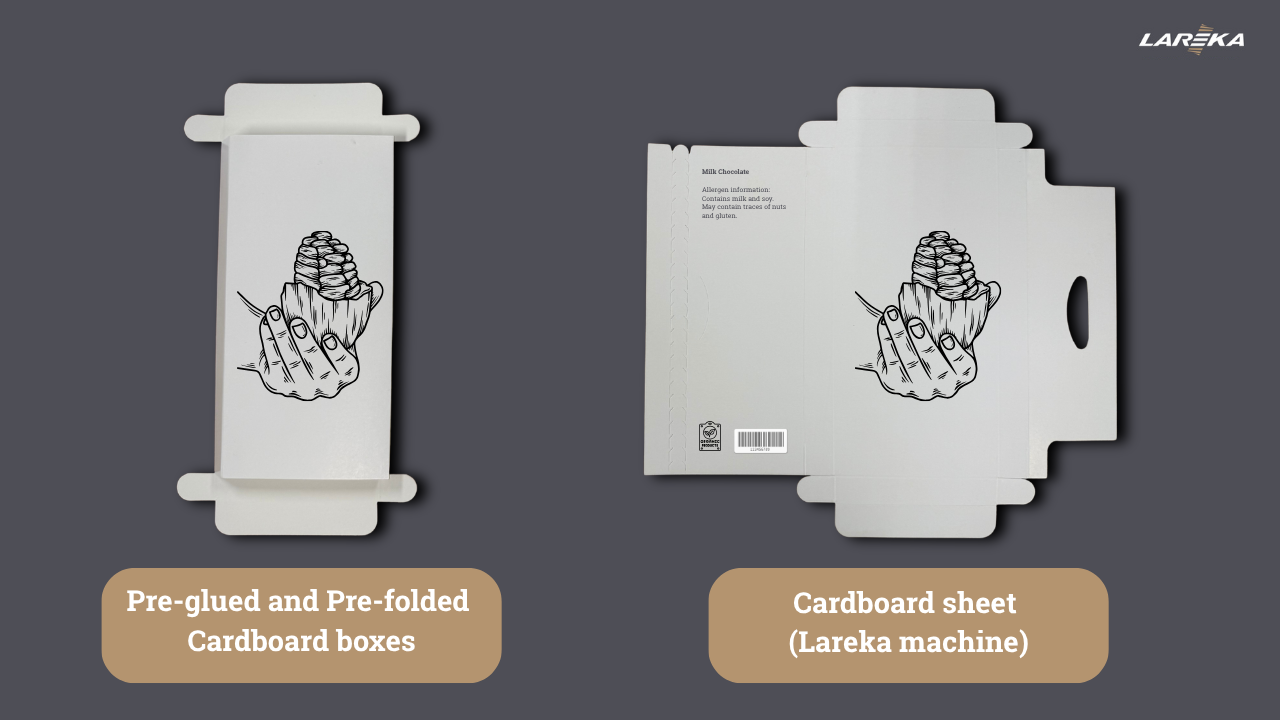
As the cardboard sheets do not come pre-glued, a glue system is necessary for the wrapping process. With 1 kg of glue, Ben can wrap approximately 70.000 bars and this will cost him approximately 72.50 euros.
Going back to our chocolatier Ben producing 100.000 bars per year, his numbers look like this:
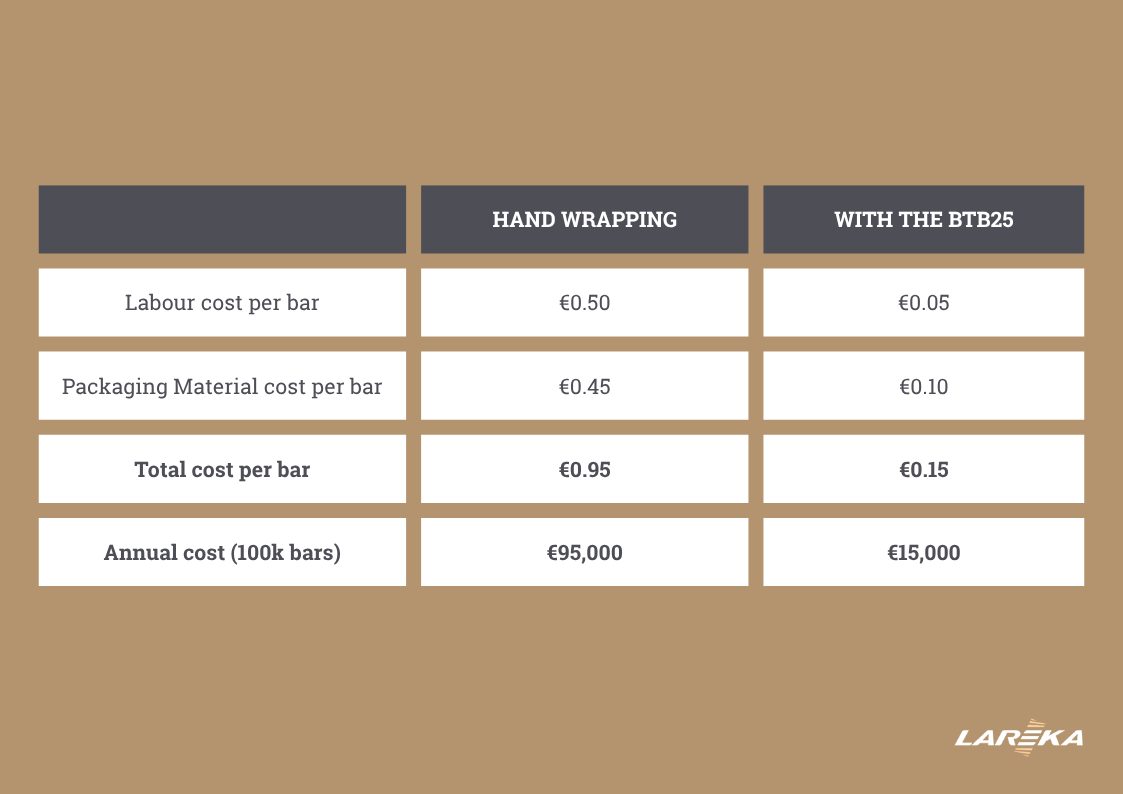
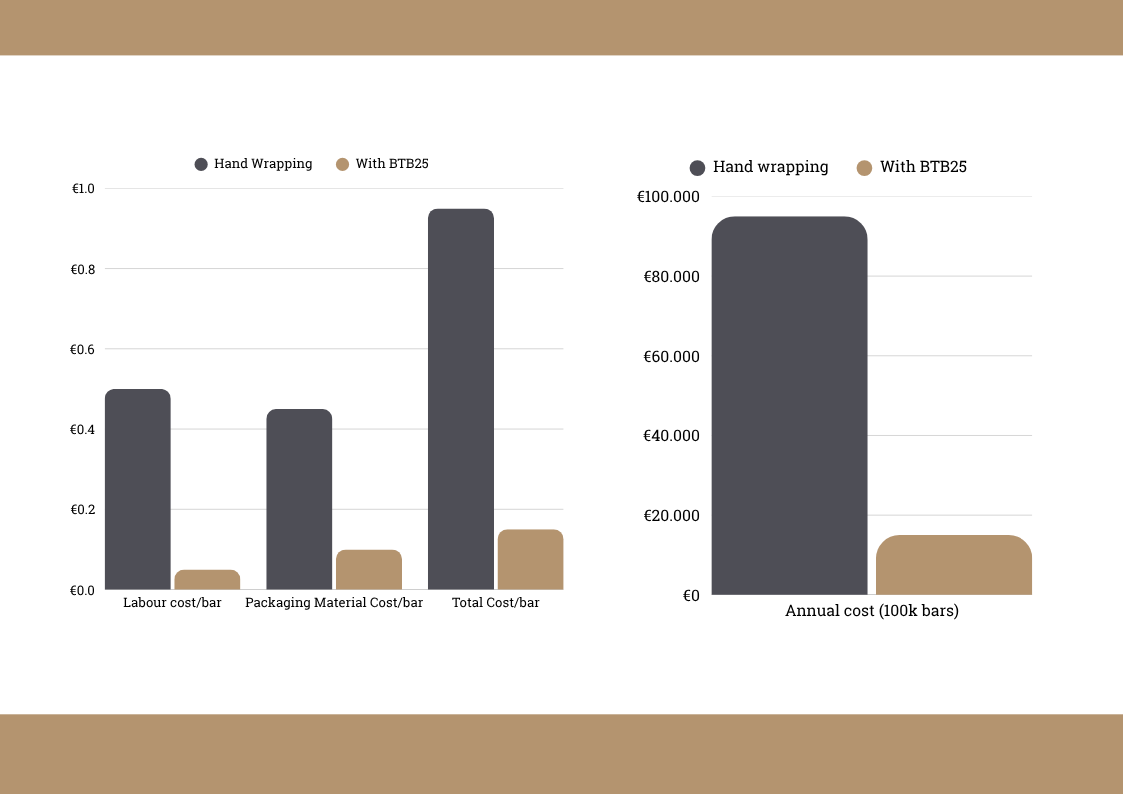
By looking at this graph, Ben would save around 80.000 euros annually (if producing 100.000 bars per year). This means that, if Ben would choose to switch from hand wrapping to a BTB25, the machine will pay for itself in roughly 2 to 3 years. Just imagine if Ben would make 200.000 or 300.000 bars per year what the savings could be!
Is this the right moment for your business?
If you're producing around 100,000 bars a year and still wrapping by hand, you're likely at the inflection point where automation starts to make serious financial sense. The BTB25 is a great solution if you are looking for a way to optimize their workflow. It's a structural improvement to your cost base, with a return that compounds every year you operate it.
Above is a description of what a business case could look like but we are aware that there are extra costs in maintenance, spare parts and service that may come up as every business case is different.
Interested in running these numbers for your specific production volume and wage costs?
We would be happy to discuss this with you, see where you could save cost by automating and help you develop a tailored business case specific to your company.
Also feel free to check out our YouTube video from the ‘How To Wrap Chocolate’ series about the Payback of a Lareka machine.
Link: https://www.youtube.com/watch?v=lS4GQi4gv5U
T: +31 402086666
E: info@lareka.nl
W: https://www.lareka.com/